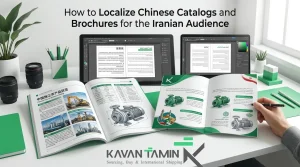
With the significant growth of imports from China and Dubai to Iran in recent years, many economic activists and traders are seeking to establish more effective relationships with their customers. Considering the active role of trading companies in facilitating purchases from foreign websites such as Alibaba, Amazon, eBay, as well as shipping from China and Dubai and customs clearance from these origins, new challenges and opportunities have emerged. In this context, the proper and systematic presentation of product information through localized catalogs and brochures has become extremely important. Catalogs that are merely machine-translated without consideration for Iranian audience culture and needs often lead to confusion and even distrust, resulting in decreased sales and damaged brand credibility. Conversely, localization of catalogs – adapting content, design, and messaging to the characteristics of the Iranian market and customer taste – not only increases sales and conversion rates but also creates a solid foundation for your brand’s credibility. This article will help you understand and implement all the essential points for successfully localizing Chinese catalogs and brochures in the Iranian market, while observing cultural, linguistic, and marketing standards.
Why is Localizing Chinese Brochures for the Iranian Market a Necessity, Not a Choice?
Understanding the cultural and psychological differences between Iranian and Chinese consumers is the foundation of successful catalog localization. In China, customers primarily make purchasing decisions based on technical specifications, price, and specific applications. However, in Iran, brand trust, clear explanations of tangible product applications, complete after-sales service information, and legal guarantees play a much more significant role. For example, Iranian customers are sensitive to shipping speed and accuracy and need to know how and when goods purchased from China, Dubai, or even foreign sites like Alibaba will reach them. If this information is not correctly reflected in the catalog, the customer feels confused, and the likelihood of purchase abandonment increases. On the other hand, experience has proven that catalogs that are merely translations from Chinese, without considering Iranian audience needs, convey a sense of unprofessionalism and even distrust. A localized catalog should convey not just the product but also the product’s story and its value in a way that makes the Iranian customer feel that this product was designed specifically for him and his market.
Step One: Conceptual and Cultural Translation (Saying Goodbye to Machine Translation)
Challenges of Direct Translation from Chinese to Persian
Direct translation of specialized Chinese texts into Persian is insufficient due to structural and cultural reasons. For example, Chinese sentence structures and the meaning of certain business terms may be completely vague or incomprehensible to an Iranian audience. In some cases, terms and expressions in Chinese business culture have no direct equivalent or common concept in Iran, requiring further explanation or modification. However, using machine translation or literal translation not only fails to meet the needs of the Iranian market but also results in incorrect or incomplete message transmission. Professional localization means rewriting the message in a language that is culturally resonant with the Iranian audience and attracts them.
Converting Technical Features into Customer Benefits (Iranian-Friendly Copywriting)
Many Chinese catalogs merely present a list of technical specifications, which can be confusing or seem irrelevant to Iranian customers. For example, providing the exact speed figure of a device’s performance is difficult to understand if not accompanied by its benefits. In localizing Chinese catalogs, it is necessary to convert these technical specifications into the language of benefits and applications. For instance, instead of “power consumption 500 watts,” phrases like “low energy consumption to reduce electricity costs” or “optimal operation with cost savings” should be used. This shift in perspective captures the audience’s attention and creates an emotional connection with the product, ultimately increasing conversion rates for purchases from foreign websites and Alibaba.
Step Two: Localizing Graphics, Colors, and Visual Identity of the Catalog
Psychology of Colors: Differences in Perspective between China and Iran
Colors are the non-verbal language of cultures. Red, which symbolizes good luck, prosperity, and celebration in China, may convey a message of stress or warning in the Iranian market, especially in the industrial sector. Excessive use of red in Iranian industrial and technical catalogs is not recommended as it reduces attractiveness and impact. Instead, using blue to convey trust and tranquility, green to indicate sustainability and health, and gray and white to create a professional and clean space can yield better results.
Adjusting Layout for Right-to-Left Readability
The Persian language is written from right to left, while Chinese is written from left to right. This difference leads to fragmented readability if the catalog is directly translated. All page elements, including text, charts, tables, and images, must be adjusted to suit Persian reading direction and right-to-left graphic standards. Such adjustments increase readability, enjoyment of browsing the catalog, and better reception of the commercial message, thus improving the buyer’s user experience.
Step Three: Aligning the Catalog with International Online Purchasing Platforms
Integration of Product Information in Bulk Purchases
If your sales are based on purchasing from foreign websites such as Alibaba, AliExpress, Amazon, or eBay, it is necessary for the catalog information to completely overlap with the product data on these sites. This coordination includes selecting the best images, clear technical specifications, and practical information. Selecting high-quality images from official sources and modifying texts and information into the Persian version is necessary, as customers want to see and receive consistent and coordinated messages and information everywhere. This adaptation not only helps increase customer trust but will also make the bulk purchasing process easier and more transparent for you.
Step Four: Clearly Presenting Logistics and Supply Information in the Brochure
Including a Precise Timeline for Goods to Reach the Final Customer
One of the most critical points in Iranian customer satisfaction is receiving goods accurately and on time. In the localized catalog, it must be clearly stated how long shipping from China or Dubai to Iran takes, the difference between air and sea freight, and how this affects delivery time. Air freight is usually faster but more expensive, while sea freight is more economical but has a longer delivery time. Clearly conveying this creates better conditions for managing customer expectations while building transparency.
Ensuring Legal and Guaranteed Customs Clearance
Another important concern of Iranian customers is ensuring the legality of the import and customs clearance process. Including in the catalog a note that the supply company (like Kavan Tamin) handles all stages of customs clearance from China and Dubai in a completely legal, professional, and risk-free manner increases trust and eliminates worries.
The Missing Link to Success: Reliable Supply with Kavan Tamin
The core strength of any import project is supply quality and after-sales support. A localized catalog must always be accompanied by the supply of high-quality goods that match the text and images in the brochure. Kavan Tamin Trading Company, with over a decade of specialized experience in purchasing from China, purchasing from Dubai, shipping from China and Dubai, and customs clearance, has always provided the best services to its customers. Kavan Tamin’s experts, with deep knowledge of the Chinese market and import regulations, accompany you at every step until results are achieved.
3 Fatal Mistakes in Localizing Chinese Catalogs
- Choosing unprofessional fonts or fonts that lack necessary readability for Persian reduces the visual quality of the text and makes reading tedious.
- Directly using low-quality images, images with watermarks, or original factory photos without professional editing severely and negatively impacts brand credibility.
- Listing products that cannot enter Iran due to customs regulations and import restrictions causes confusion and wastes advertising and sales budgets. Carefully reviewing and removing unnecessary items, and correctly selecting visual and content elements, are points that cannot be ignored.
Conclusion: Creating a Powerful Bridge Between Chinese Products and Iranian Buyers
Catalog localization is a long-term investment essential for brand credibility and sales growth, not merely an extra cost. This process ensures that the product’s message is conveyed clearly, attractively, and effectively in the Iranian market, and that customer trust is gained. If this path is followed correctly, you can create a powerful bridge between the Chinese manufacturer and the Iranian buyer, ultimately leading to trade growth and sustainable development.
Frequently Asked Questions
Q: Should we translate all products in the Chinese company’s catalog?
A: No. It is better to select and localize only the products that suit the needs of the Iranian market and comply with Iran’s import regulations, to avoid wasting cost and time on unnecessary items.
Q: What is the best software for editing Chinese brochures?
A: Professional software like Adobe Illustrator and Adobe InDesign are the best options for editing source catalog and brochure files, as they provide full control over layout and text.
Q: How can I find suitable products to include in the catalog from China?
A: By using specialized sourcing services of companies like Kavan Tamin – which, with their mastery of the Chinese market and knowledge of import regulations, introduce you to the best products according to the needs of the Iranian market – you can make better selections.